Look development / Lighting / Rendering / Review
Roji carries look development, lighting, rendering and review in a single application, built for heavy duty work: hyperscaled scenes, complex shows and the frames nobody else wants to take.
Registration for the studio beta is open: test Roji on your own shots, inside your own walls.
Roji
Every light writes its own pass. Drag to relight without rendering again.
Today this takes a look development tool, a lighting application, a renderer and a review player, with an export between every one of them. Roji is the four of them sharing a scene, plus the viewport to judge it in, and an AI to help run it.
USD authoring with per-node history. Layers and composition arcs are preserved, never collapsed, and lighting stays standard USD Lux.
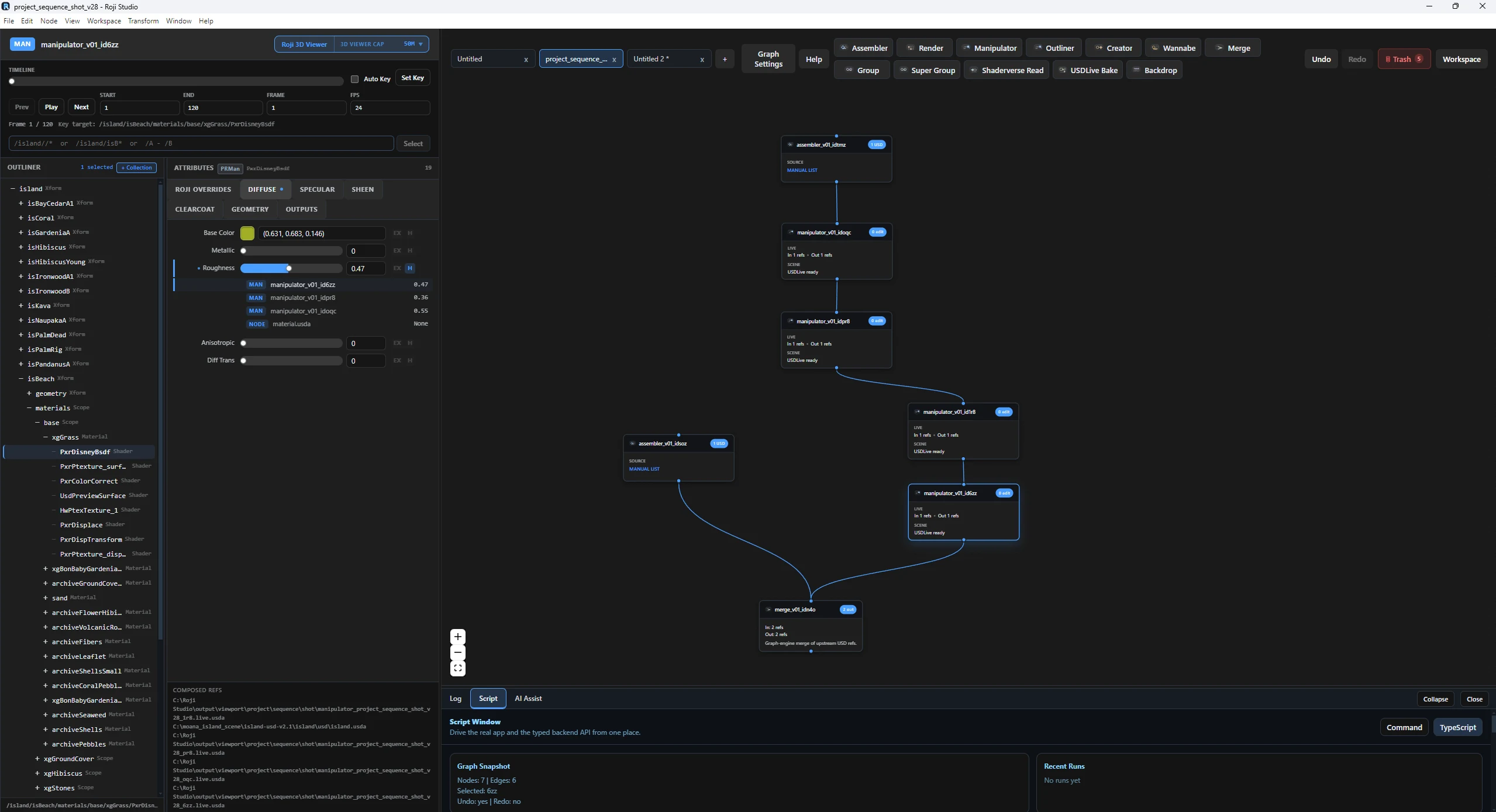
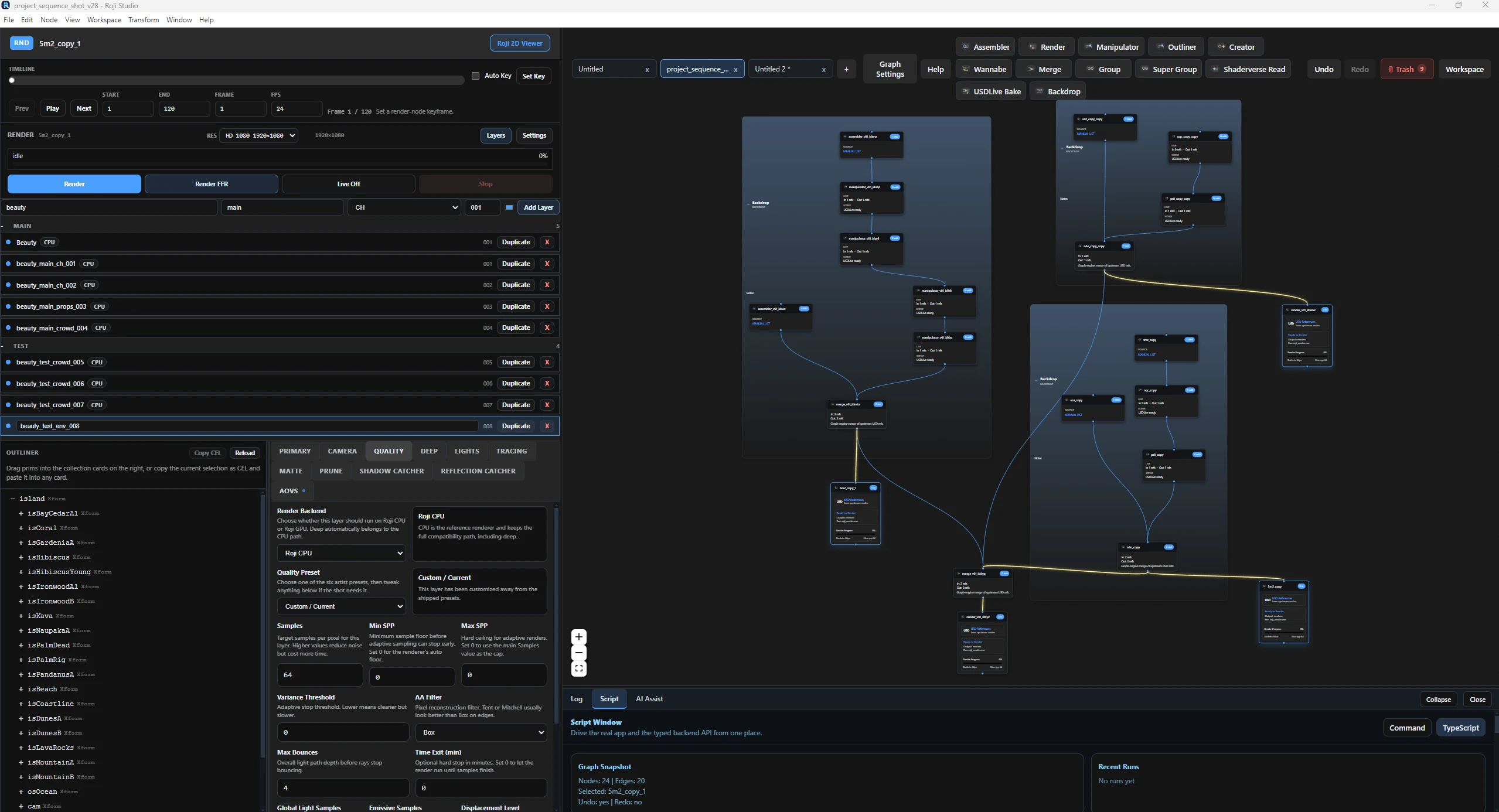
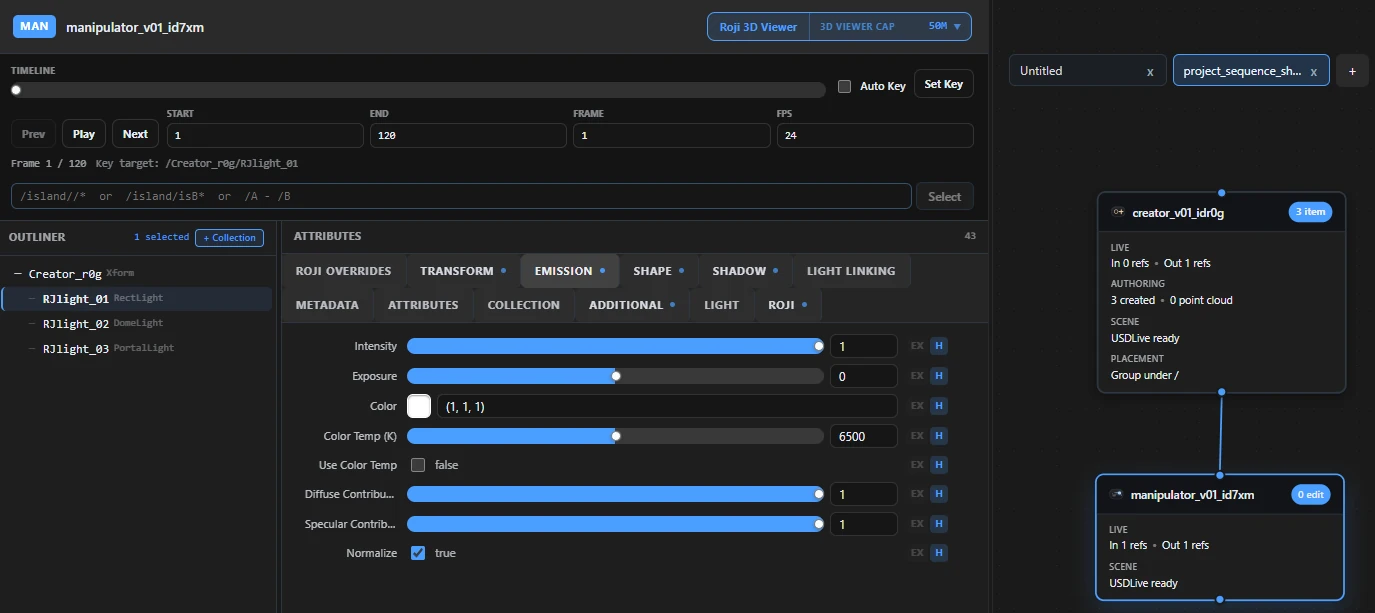
The Manipulator and Render nodes captures show the Moana Island Scene, © 2017-2022 Disney Enterprises, Inc., a public dataset shown here as a technical benchmark. No endorsement, sponsorship or affiliation is implied.
A small set of focused node types covers the stages of a scene, so what each one did stays readable and can be checked.
Composes USD prims, references, payloads and variants into the working scene graph.
Spawns USD prims directly: meshes and basic shapes, USD Lux lights with their filters, cameras and camera projections, point instancers, volume boxes, and the Xform groups that hold them.
Interactive USD attribute editor, with per-instance edit history and full provenance.
Combines two USD streams into one composition, with explicit override semantics.
Per node, not per application. Each one shows the live composed USD at its own place in the graph, filtered by type, kind, purpose or activation.
Final pixels through Roji Render: CPU or GPU backend, AOVs, frame ranges and light groups.
Collapses a sub-graph into a reusable node, with the sockets you choose exposed.
Loads a whole graph as a live sub-graph. Reuse a shot template, keep the source connected, and override either side when the shot asks for it.
Live-links a Shaderverse look into the graph. Edit the material, see it in the viewport.
Bakes the live composed state to a flattened USD layer, for deliverables, pipeline requests and frozen trees.
A pass-through script node for graph-level transforms. It carries the script, the USD override layers it declares and its outliner masks downstream.
The custom-node experiment: try extra graph logic without touching the core node set.
OpenPBR surfaces and MaterialX wrapped in USD, with the graph, previews, parameters and assignments in one inspectable place.
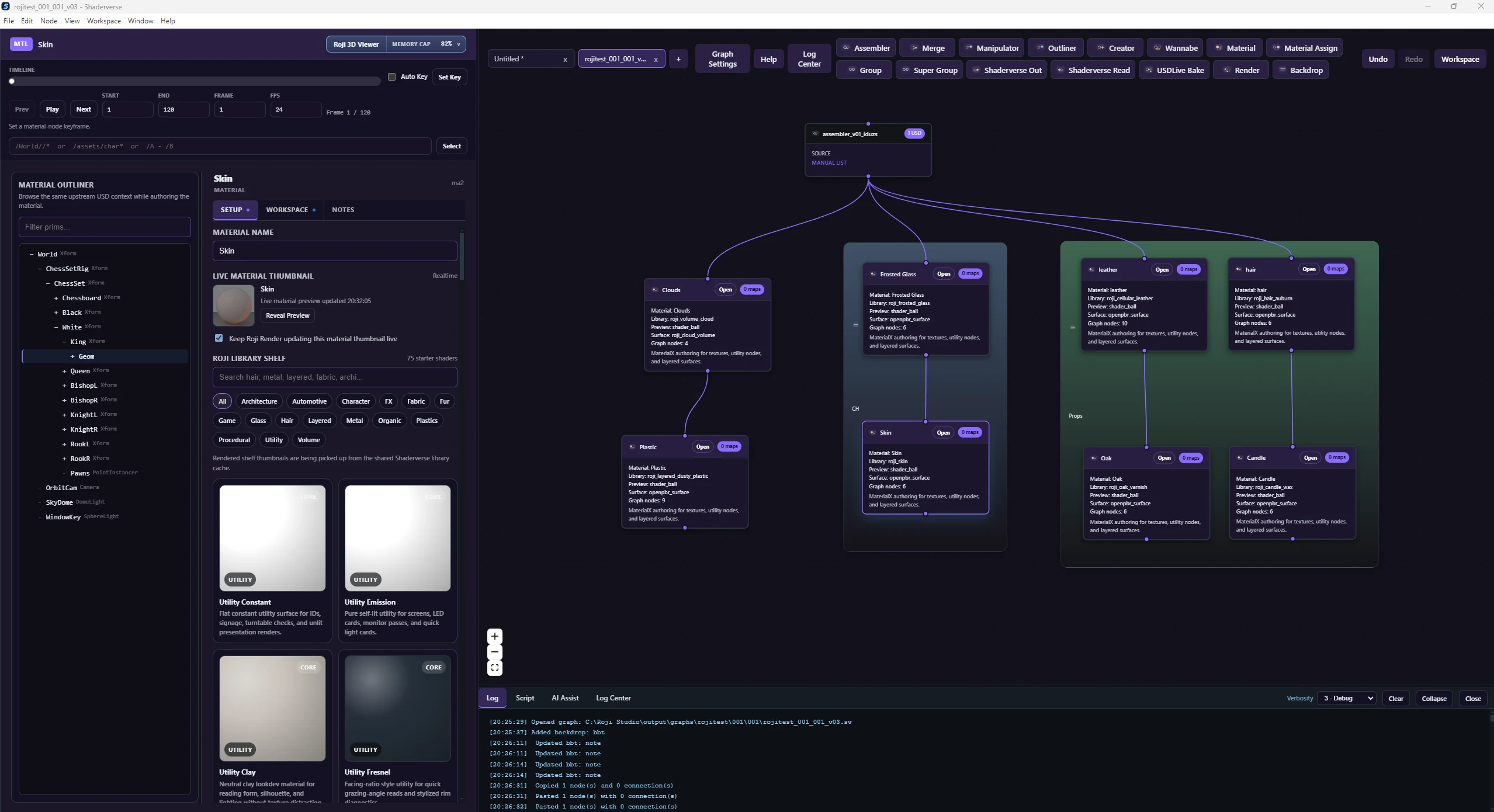
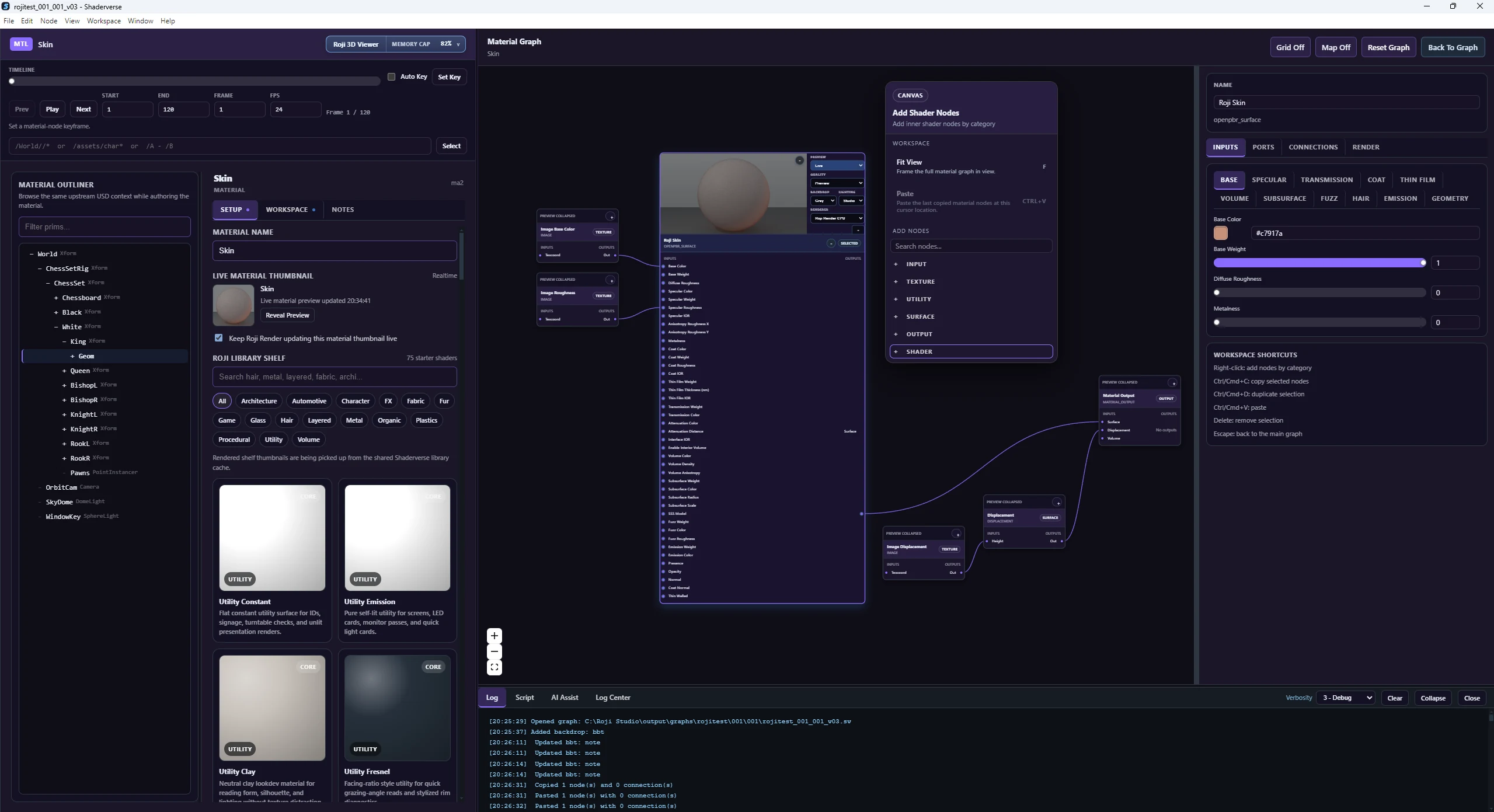
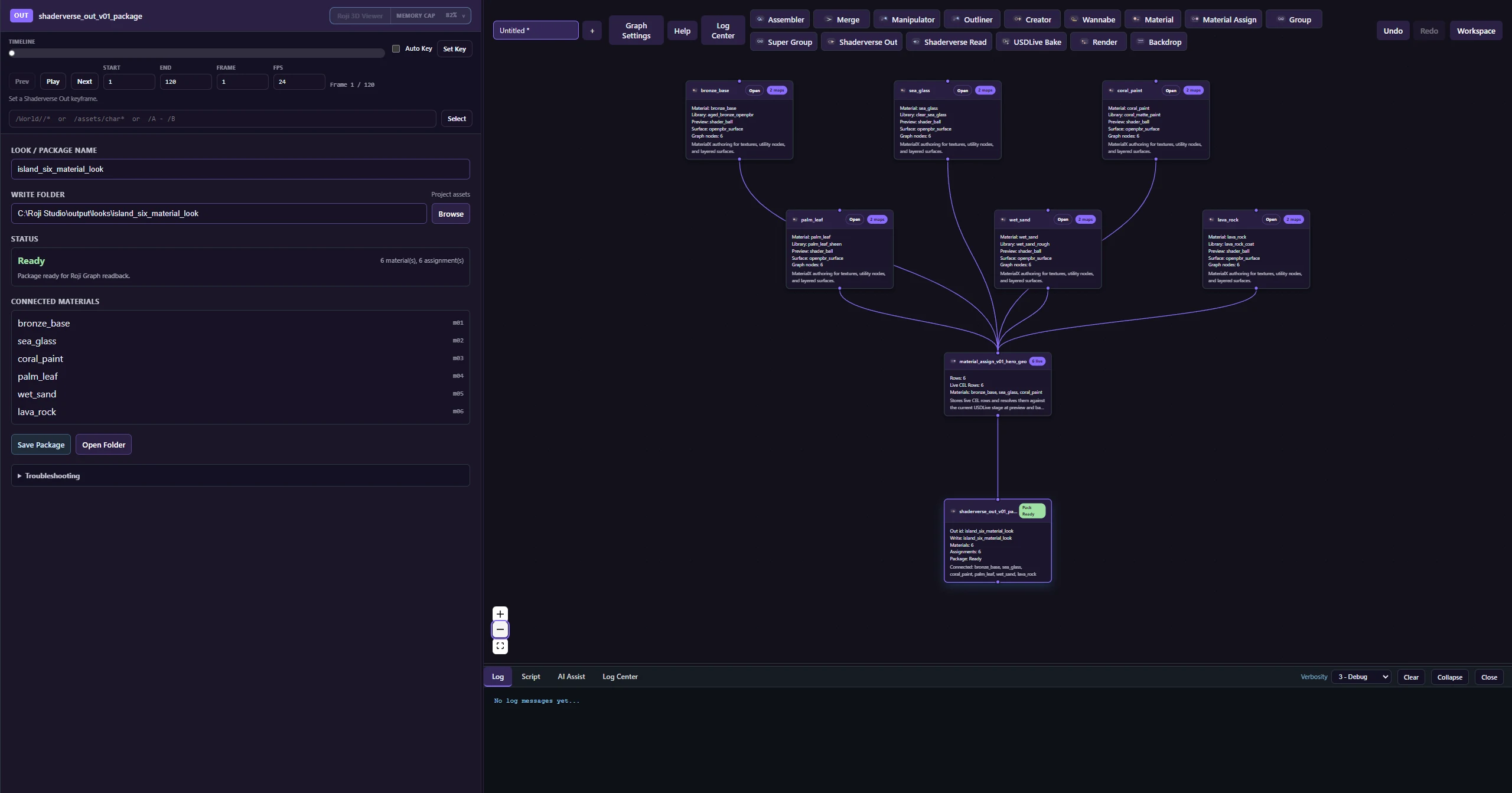
The scene in the Materials and Material graph captures is The Open Chess Set by Moeen and Mujtaba Sayed, published by the Academy Software Foundation under CC BY 4.0.
Holds heavy USD with visible memory limits and proxy behaviour, and opens a viewer per branch when you need to compare two looks.
Per node, not per application. In a classic DCC the viewport is built into the software. In Roji every node has its own 3D Viewer: open one at any time, and it updates in real time as the hierarchy upstream changes.
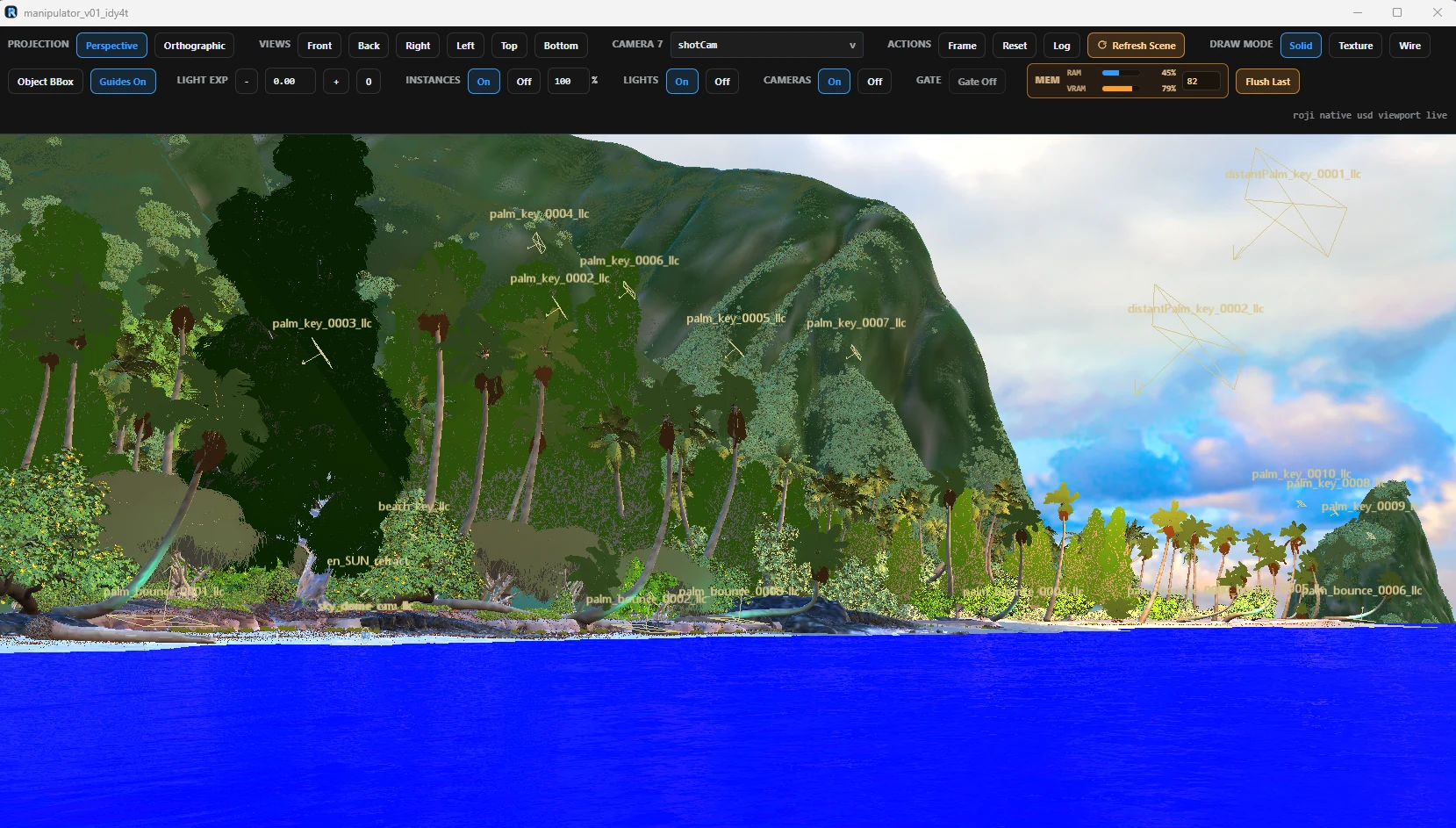
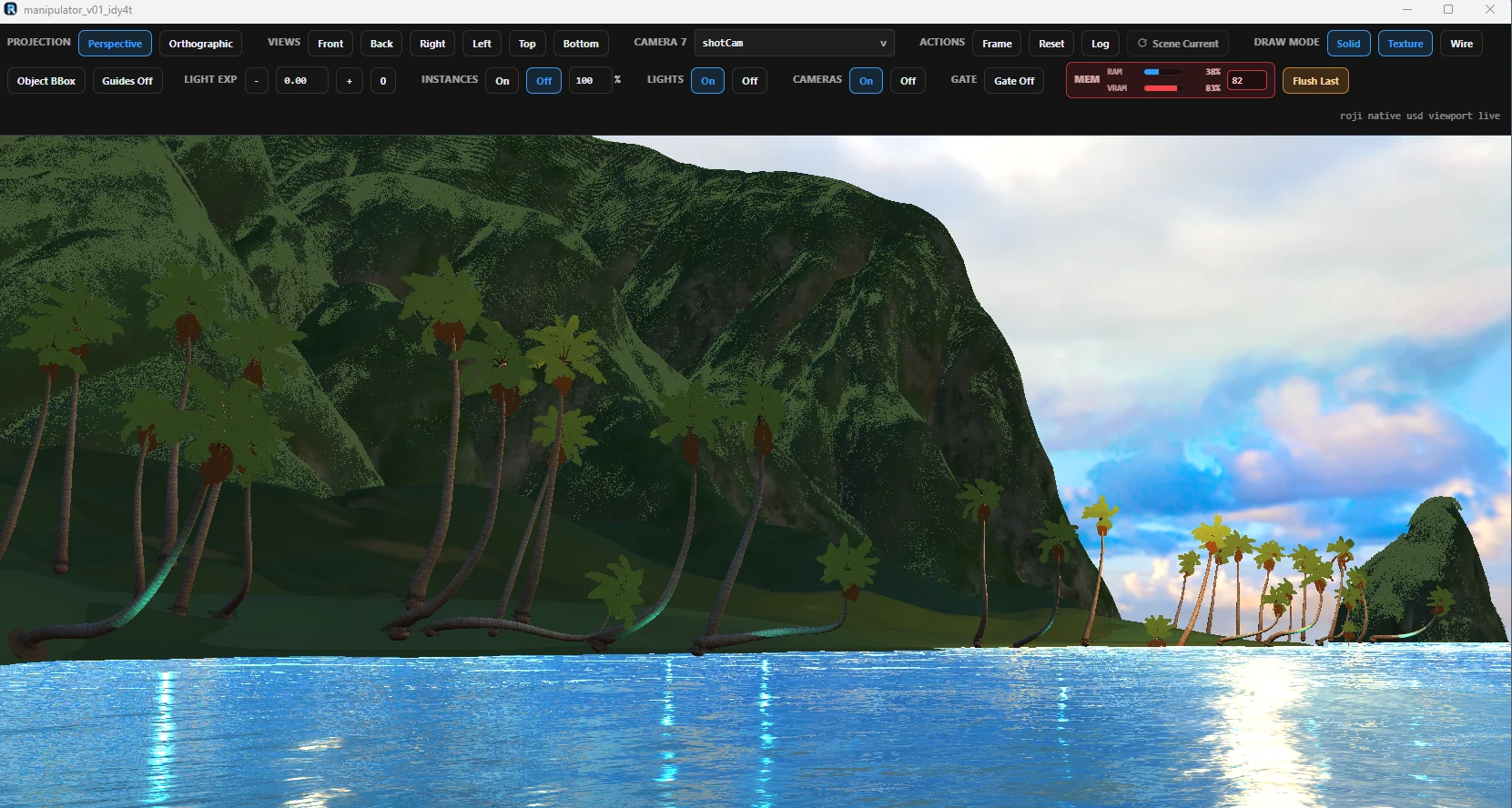
Datasets shown as technical benchmarks, with no endorsement, sponsorship or affiliation implied: the Moana Island Scene, © 2017-2022 Disney Enterprises, Inc.; “Animal Logic ALab”, Copyright 2022 Animal Logic Pty Limited, all rights reserved, under the ASWF Digital Assets License v1.1; and The Open Chess Set by Moeen and Mujtaba Sayed, published by the Academy Software Foundation under CC BY 4.0.
CPU, GPU or both on the same frame. AOVs, deep EXR, Cryptomatte, light groups and OpenColorIO.
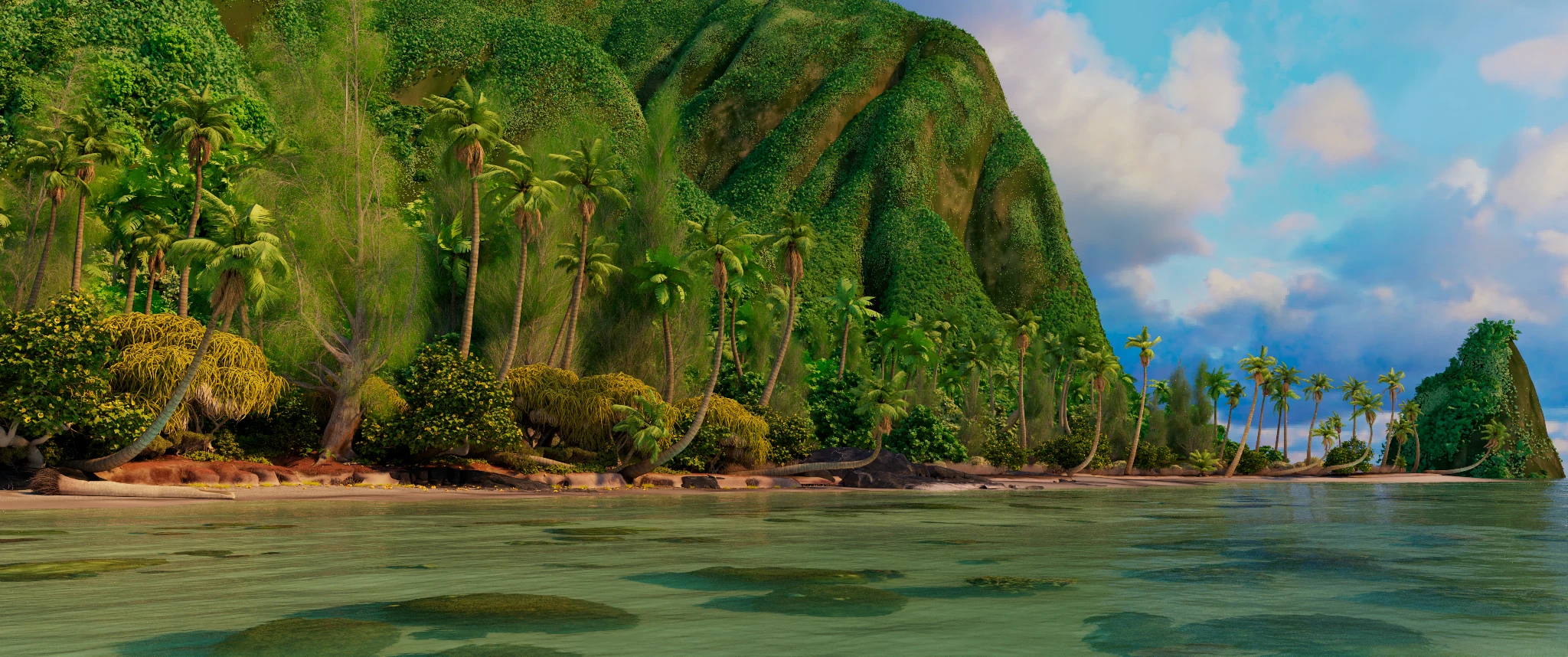
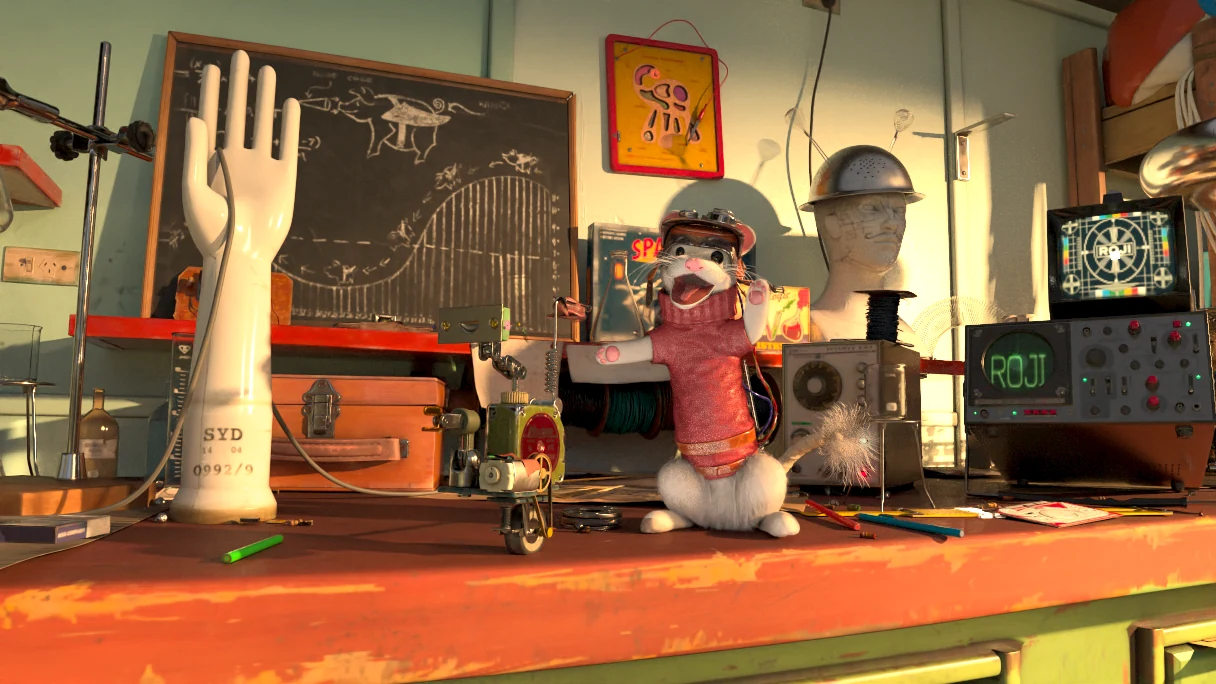
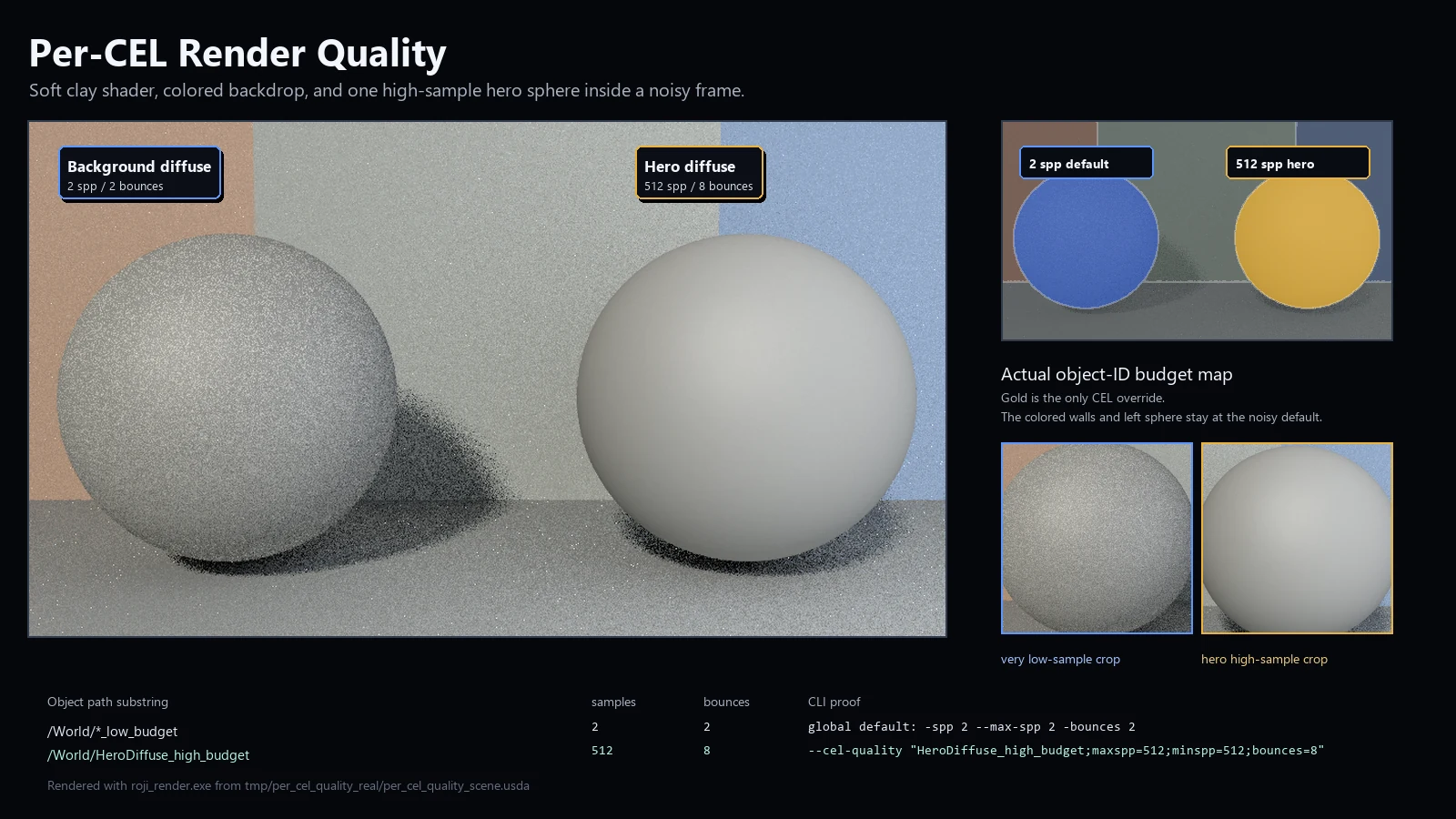
Datasets shown as technical benchmarks, with no endorsement, sponsorship or affiliation implied: the Moana Island Scene, © 2017-2022 Disney Enterprises, Inc.; and “Animal Logic ALab”, Copyright 2022 Animal Logic Pty Limited, all rights reserved, under the ASWF Digital Assets License v1.1.
The same viewer contract on the desktop and online, with a portable stats page carrying light groups for relight checks.
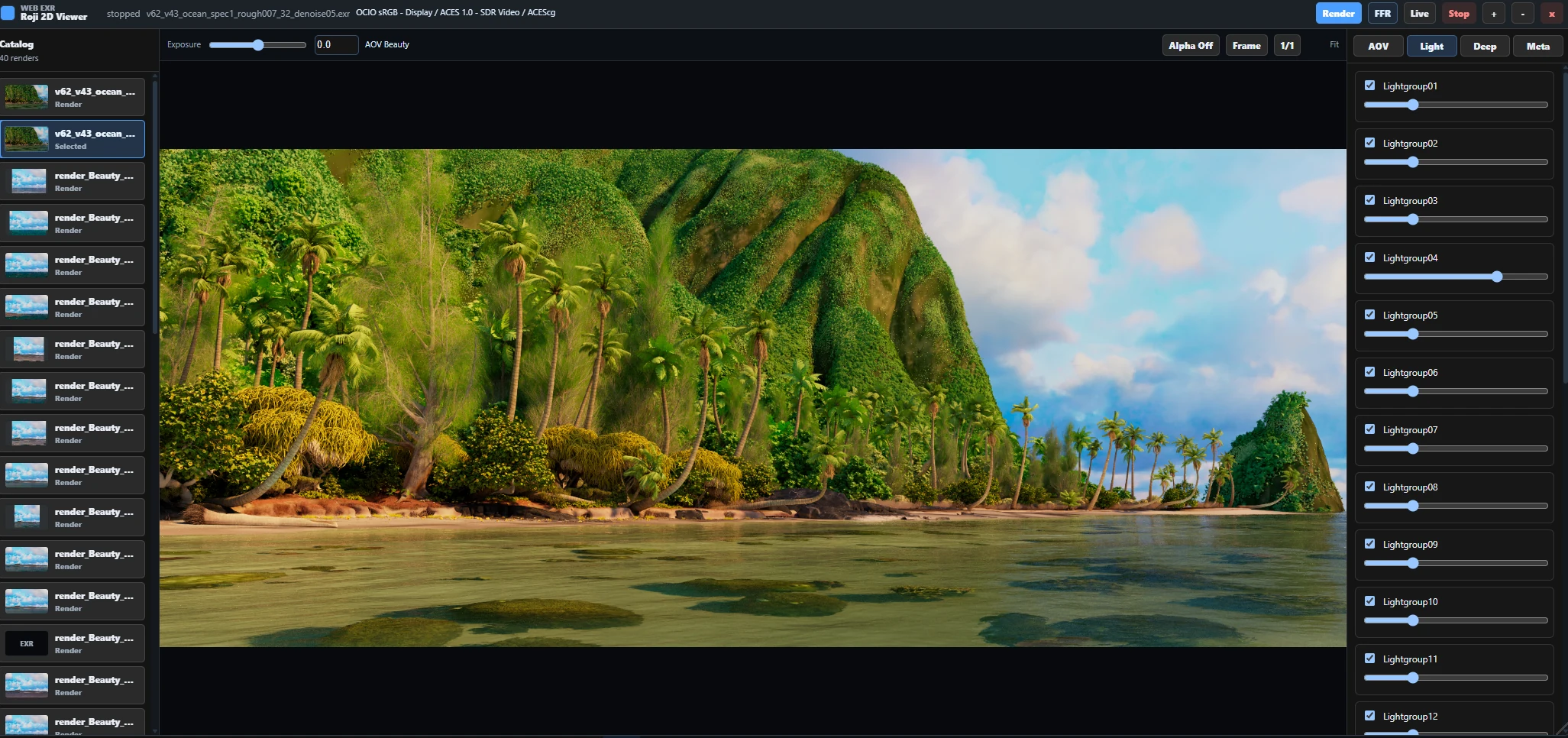
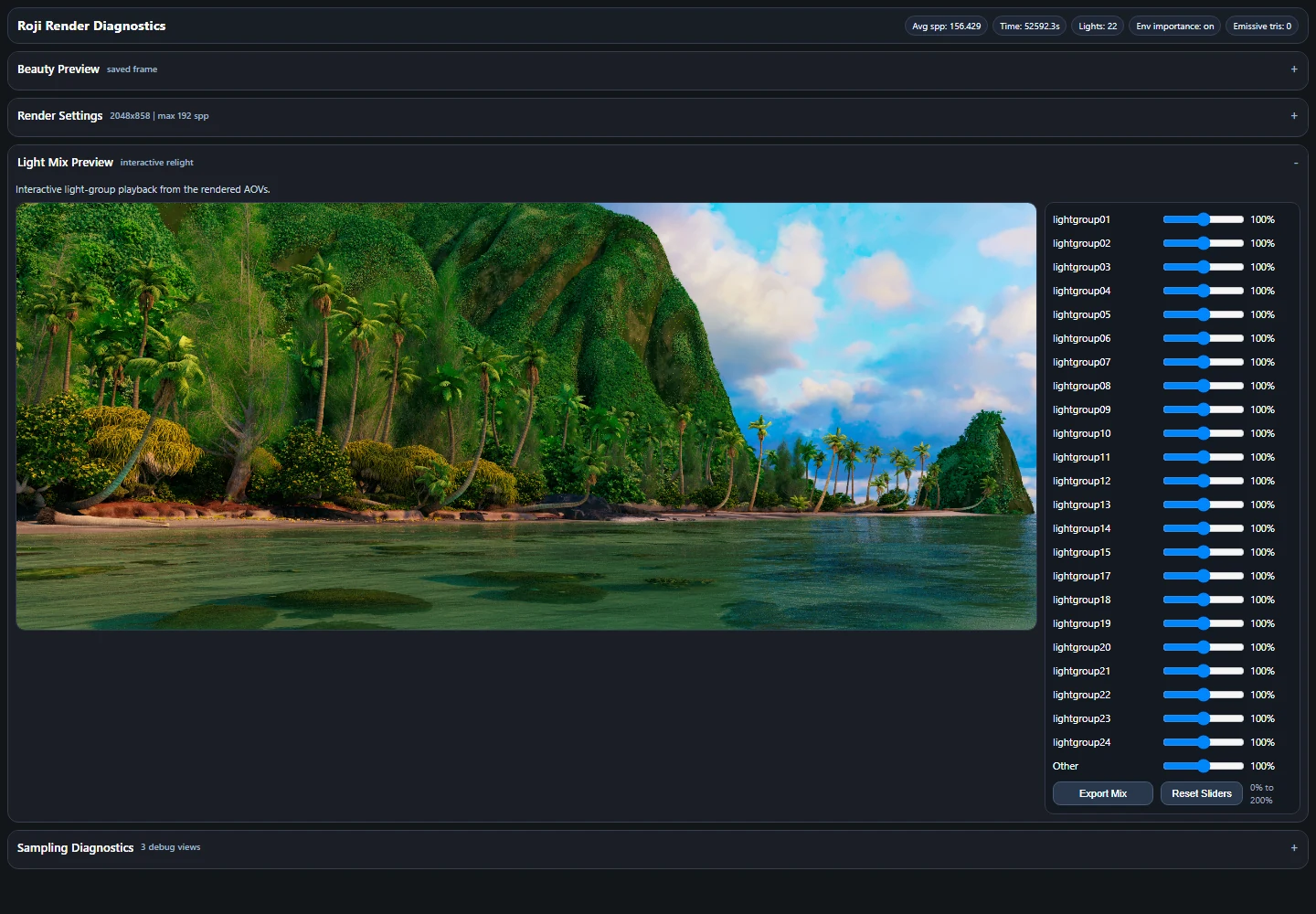
The captures show the Moana Island Scene, © 2017-2022 Disney Enterprises, Inc., a public dataset shown as a technical benchmark. No endorsement, sponsorship or affiliation is implied.
Roji AI works on the same readable graph, USD, shader, render and log files you do. It inspects, debugs, launches, monitors and fixes, from any device, and every step stays open for review.
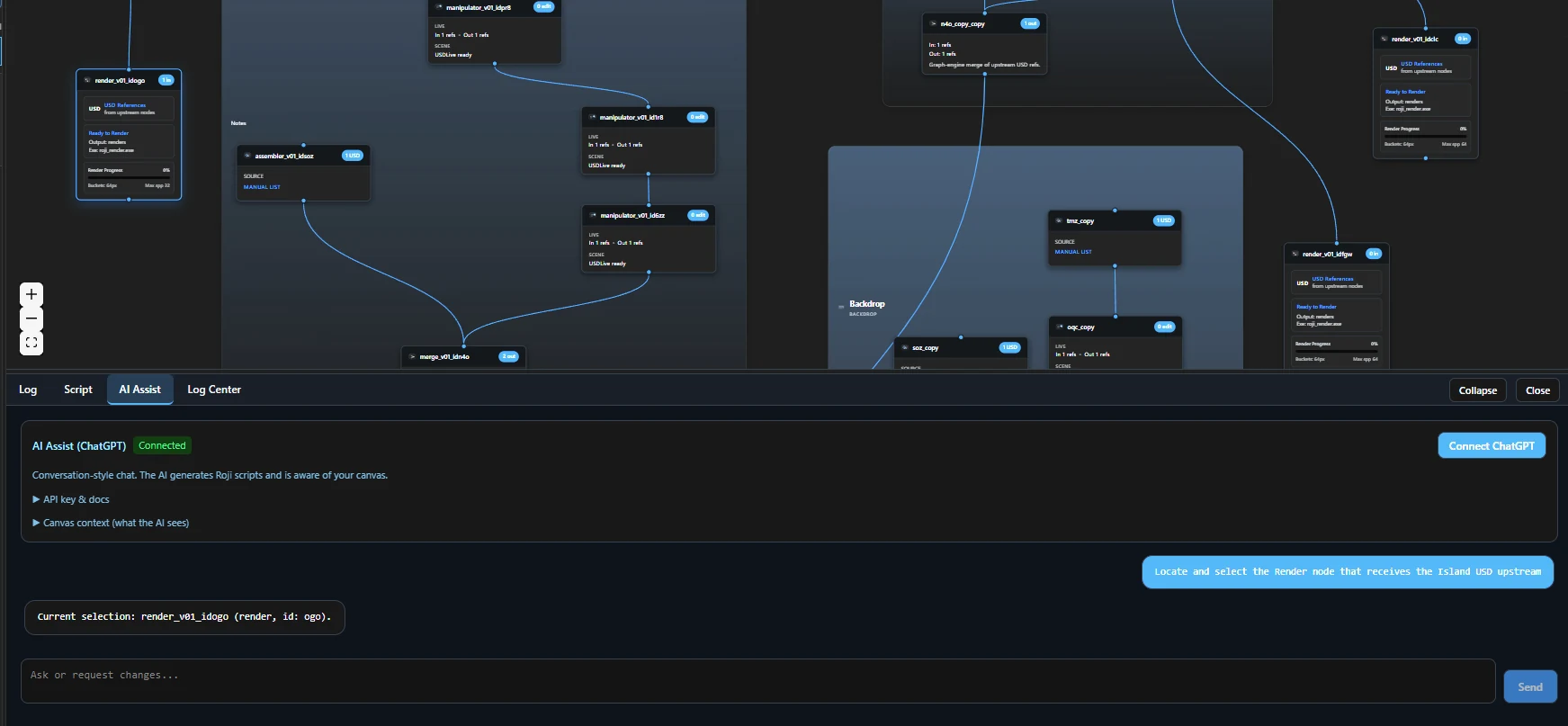
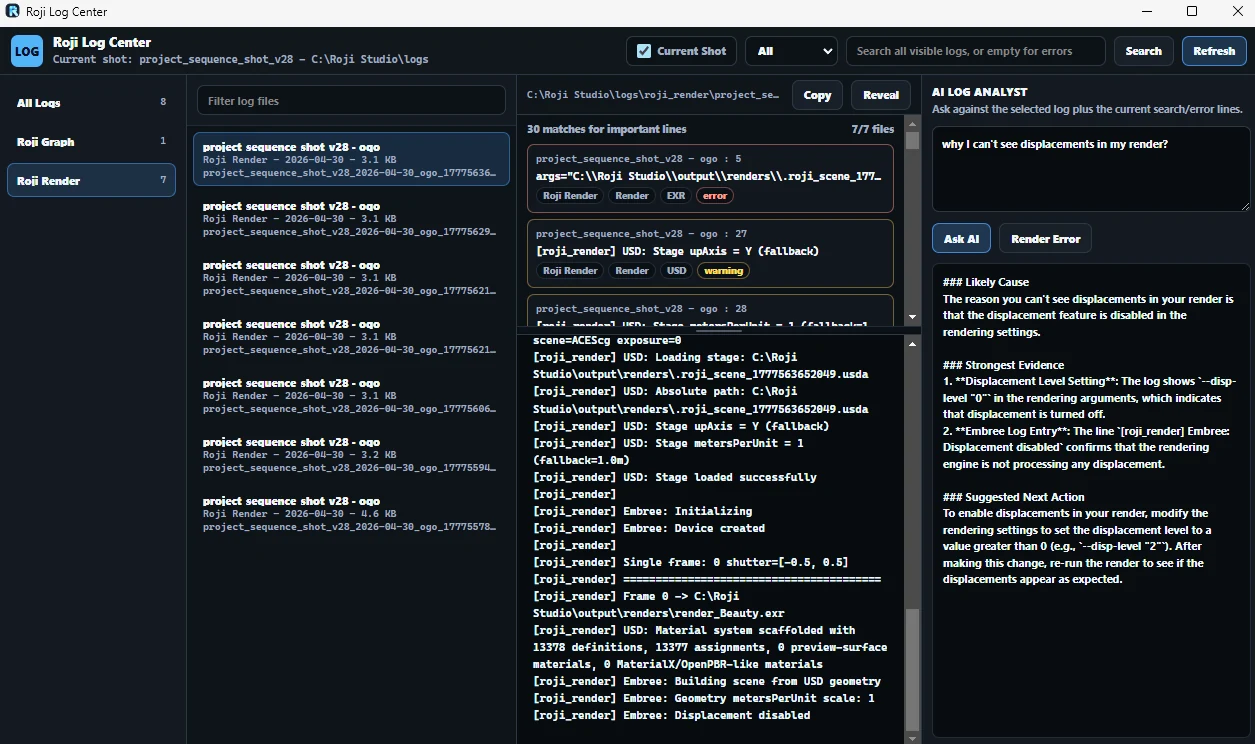
Roji AI is research in progress: current experiments run against the OpenAI API, and nothing the AI proposes is applied without review.
Roji has been tested against the largest public 3D scene benchmarks available, and scored among the highest measured. This is the technology underneath.
The show is paged in as the frame asks for it, so a scene far larger than your memory renders in one take. No proxies, no splitting the shot, no rebuilding it to fit.
Geometry reaches the GPU on the rays that actually touch it, so the card holds what the frame is using, not everything you own. That is how a machine renders a set it could never load.
The renderer learns where the light in your shot really comes from and aims rays at it instead of guessing. One field, trained once: the CPU and the GPU sample the same one.
Proprietary handover technology: the GPU can pass any bounce back to the CPU at any moment, and the CPU can do the same, on the same frame. Neither processor ever sits idle waiting for the other.
The interface holds no engine and never assumes one sits on the same machine. Artists work from a laptop, a tablet or a browser while the engines run on the workstation, the farm or the cloud.
Roji HUGE was selected for SIGGRAPH Asia 2026 Technical Communications: Automatic Morton Spatial Compilation for Production Rendering and Visualization. The paper covers the spatial compilation that renders a scene larger than memory in one take.
99.01%
CPU and GPU agreement, measured in a strict stress-test environment.
Research measurement, not a release certification.
Roji is in private beta and registration is open to studios: run it on real work, inside your own walls, with our team alongside.
Studios only for now. Access for individual artists opens in stages.
Studios of any size, in animation, visual effects, games or commercials. Requests are reviewed one studio at a time. Access for individual artists opens in stages.
No. Roji reads and writes USD, OpenPBR and MaterialX, and hands compositing AOVs, deep EXR and Cryptomatte. It joins what you have rather than asking you to leave it. It also reads RenderMan shaders, tex files, Ptex and most of what sits between.
No. Roji runs on your workstations and your farm, and nothing leaves your machines unless you send it. It can run on an isolated farm with no network at all.
Yes. The interface runs on a laptop, a tablet or a browser and talks to engines wherever they live, so one workstation or a cloud machine can serve a crew that is not in the room.
Real shots and honest notes: what breaks, what is slow, what is missing. Bug reports go through a flow you agree to first, and fixes come back as tracked releases.
At rojiresearch.com/research: the methods, the benchmarks, and the CPU and GPU parity records.
 roji
roji